
There is a particular kind of quiet panic that comes from finding something on your body that you weren’t expecting.
A lump or bulge in the underarm — the axilla, if we’re being precise — is one of those findings.
Patients sometimes arrive at the clinic having already searched every possibility and understandably fearing the worst.
So let’s begin somewhere more useful.
An axillary bulge is not a diagnosis. It is a finding.
And there are several very different things that can produce it.
The Usual Suspects
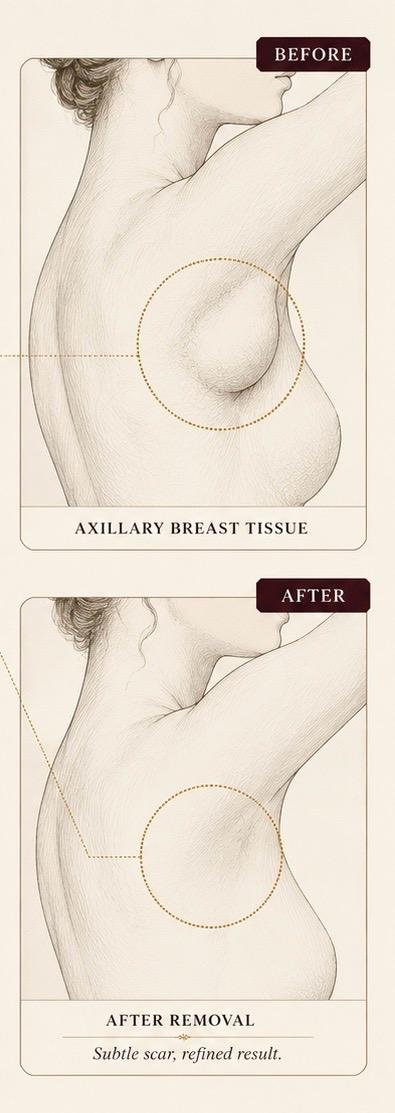
Accessory Breast Tissue
This is one of the important — and often overlooked — causes of a soft fullness in the underarm.
During early development, breast tissue forms along an embryological ridge commonly called the milk line. Most of this tissue regresses, leaving the breasts in their usual position.
Sometimes, however, breast tissue remains elsewhere along that developmental pathway — most commonly in the axilla.
And because it is breast tissue, it can behave like breast tissue.
It may become fuller or tender around menstruation, become more noticeable during pregnancy, or simply remain as a soft bulge that has been present for years.
It is a developmental variation, not a disease.
Lipoma
A lipoma is a benign collection of fat cells.
It is typically soft, mobile, painless and slow-growing. Many require no treatment unless they become uncomfortable, increase significantly in size or are cosmetically troublesome.
Enlarged Lymph Nodes
The axilla contains an important group of lymph nodes — part of the body’s immune and drainage system.
These nodes can enlarge for many reasons, including inflammation or infection involving the arm or breast, recent vaccination and several other conditions.
Many reactive lymph nodes settle once the underlying trigger disappears.
Persistent or suspicious nodes, however, need proper assessment.
Hidradenitis Suppurativa
Hidradenitis suppurativa is a chronic inflammatory condition involving hair follicles, commonly affecting areas such as the armpits and groin.
Unlike a simple soft bulge, it may produce recurrent painful nodules, abscesses, drainage or scarring.
It deserves proper diagnosis and long-term treatment rather than repeatedly treating individual lumps as isolated infections.
When Should an Axillary Lump Be Checked?
The answer is simpler than people sometimes expect:
If it is new, unexplained or persistent, have it examined.
Particular reasons to seek assessment include:
- A lump that feels hard or fixed
- Noticeable or rapid enlargement
- Persistent swelling that does not settle
- Skin dimpling, ulceration or other skin changes
- Associated breast changes or nipple discharge
- Recurrent painful or draining lumps
- Unexplained fever, night sweats or weight loss
These findings do not automatically mean something serious.
They simply mean the lump deserves to be identified rather than guessed at.
So How Do We Work Out What It Is?
Usually, we start with something remarkably simple:
A proper clinical examination.
The location, consistency, mobility and relationship of the swelling to the breast and surrounding tissues already tell us a great deal.
When needed, ultrasound can then help distinguish breast tissue, fatty tissue, lymph nodes and other soft-tissue lesions.
Depending on the patient’s age and findings, additional breast imaging or further investigation may occasionally be required.
“First identify the bulge. Then decide what — if anything — needs to be done about it.”
And Very Often, the Conversation Becomes One About Axillary Breast Tissue
There is a particular pattern I see frequently.
A woman has had a soft fullness near the front of the armpit for years.
It becomes more obvious in fitted clothing.
Perhaps it feels fuller or more uncomfortable around her menstrual cycle.
It may have become particularly noticeable after pregnancy or changes in weight.
Once examination and appropriate imaging confirm that this is accessory axillary breast tissue, the conversation changes completely.
We are no longer asking, “What is this lump?”
We are asking, “Does it bother you enough to do something about it?”
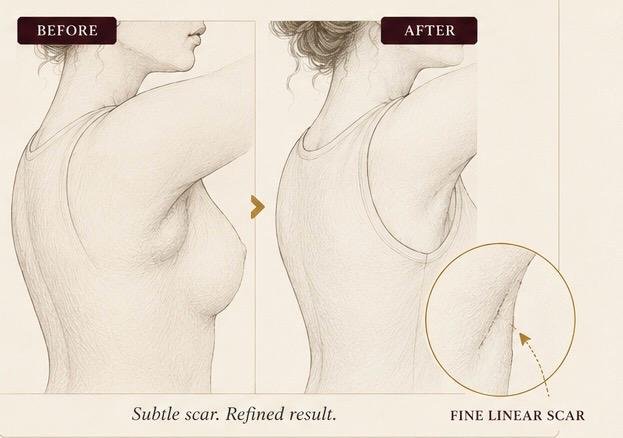
Accessory breast tissue itself does not automatically need treatment.
If it causes no discomfort and the appearance does not concern you, it can simply be left alone.
But if it creates fullness under clothing, irritation, tenderness, difficulty with arm movement or significant cosmetic concern, treatment can be considered.
Watch
Axillary Breast Tissue Explained
Dr Catherine Samraj explains why this underarm fullness may remain despite exercise or changes in weight.
Treating Axillary Breast Tissue
The right approach depends on what is creating the bulge.
Some axillary fullness is predominantly fatty.
Some contains a significant amount of glandular breast tissue.
Some also has loose or excess skin.
That is why there is no single operation that is right for every patient.
Liposuction can be useful when fatty tissue forms a significant part of the fullness.
Surgical excision allows more substantial glandular tissue or excess skin to be removed.
And in many patients, a combination of liposuction and excision provides the most appropriate contour.
The procedure should be designed around the anatomy — not the other way around.
The Real Point
The underarm is an anatomically busy part of the body.
Fat, breast tissue, lymph nodes, skin structures and other soft tissues all occupy a remarkably small space.
So when a lump appears there, the answer is neither panic nor self-diagnosis.
It is identification.
Find out what it is first. Then decide whether it needs treatment.
And if it turns out to be accessory breast tissue, the conversation becomes much less frightening.
It is no longer about a mysterious lump.
It is simply about whether something benign is bothering you — and what can reasonably be done to improve it.
Bodies are not mysteries to be feared.
They are stories to be read correctly, in the right order.
And that is precisely the work.