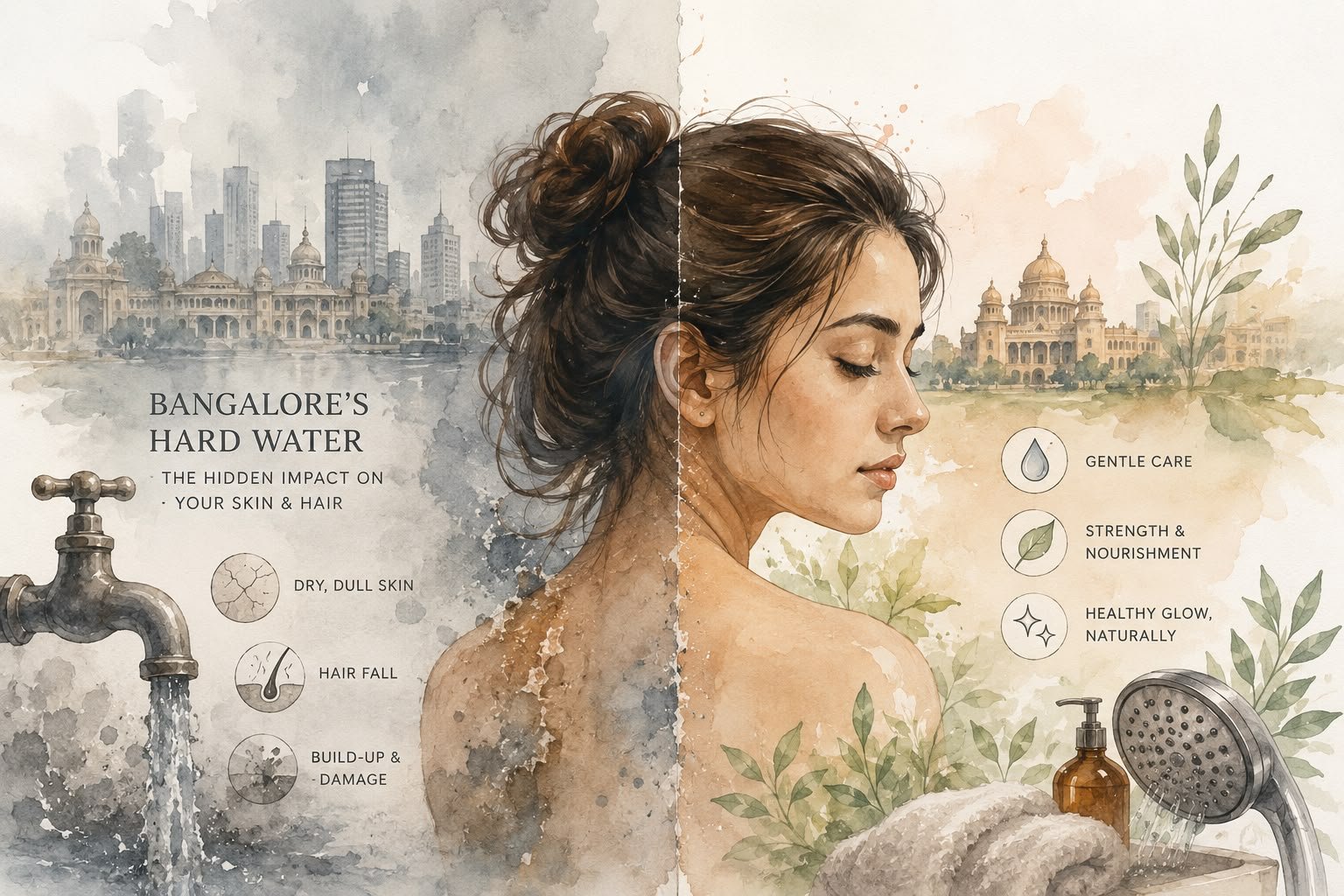
If you have moved to Bangalore and suddenly found yourself asking, “Why does my hair feel different here?” you are not alone.
Hard water is one of the most frequently blamed causes of dry skin, rough hair and hair fall in Bangalore. While water quality can affect the way your skin and hair feel, the relationship is more nuanced than simply saying that hard water causes hair loss.
So, what exactly is hard water? What does it actually do to the skin and hair? And, more importantly, what can you realistically do about it?
First, What Exactly Is Hard Water?
Hard water is water that contains higher concentrations of dissolved minerals, particularly calcium and magnesium.
This does not necessarily mean that the water is unsafe to use. Hardness describes the mineral content of water.
The water reaching homes across Bangalore can vary depending on the source of supply, the area you live in and the water system used by your building.
This means that two people living in different parts of the city, or even in different apartment complexes, may have very different experiences with their water.
This is also why one person may move to Bangalore and notice an immediate difference in their hair and skin, while another may notice very little change.
How Does Hard Water Affect the Skin?
Your skin has a natural protective barrier. This barrier helps retain moisture while protecting the skin from environmental irritants.
When this barrier is disturbed, the skin may feel:
- Dry
- Tight
- Rough
- Itchy
- More easily irritated
Hard water can interact with soaps and cleansing products differently from softer water. Mineral deposits and residue from cleansing products may remain on the skin, particularly when harsh soaps or frequent hot showers are also part of the routine.
For someone who already has dry, sensitive or eczema-prone skin, this may make the skin feel more uncomfortable.
However, hard water is rarely the only factor involved.
Weather, air conditioning, hot showers, over-cleansing, strong active ingredients, underlying skin conditions and the products you use can all affect the skin barrier.
So, if your skin suddenly becomes dry after moving to Bangalore, the water may be part of the picture, but it may not be the entire story.
Why Does My Skin Feel Tight After a Shower?
That “squeaky clean” feeling is not always a sign that your skin is cleaner.
Sometimes it means that too much of the skin’s natural surface oil has been removed.
Long hot showers, harsh soaps and frequent cleansing can all contribute to this. In hard water, the interaction between minerals and cleansing products may further contribute to residue and irritation in some people.
If your skin feels tight immediately after bathing, your routine may need to focus less on aggressive cleansing and more on protecting the skin barrier.
How Does Hard Water Affect the Hair?
Hair is a fibre.
Unlike living skin, the visible hair shaft cannot repair itself once it has been significantly damaged.
Minerals present in hard water can deposit on the surface of the hair over time. Depending on the individual and the degree of exposure, this may contribute to hair that feels:
- Rough
- Dry
- Dull
- Tangled
- Difficult to manage
- More prone to breakage
You may also feel that your shampoo does not lather as easily or that your hair never quite feels clean despite repeated washing.
This can create another problem.
When the hair does not feel clean, many people respond by washing it more aggressively, using stronger shampoos or shampooing repeatedly.
That can leave the hair even drier.
But Does Bangalore’s Hard Water Actually Cause Hair Fall?
This is where we need to be careful.
Hair breakage and hair loss are not the same thing.
If the hair shaft becomes dry, rough or fragile, it may break more easily. This can make the hair appear thinner and can feel like increased hair fall.
But true hair loss from the root may have many other causes, including:
- Nutritional deficiencies
- Thyroid disorders
- Significant stress
- Recent illness or surgery
- Rapid weight loss
- Hormonal changes
- Postpartum changes
- Genetic hair loss
- Scalp conditions
- Certain medications
If you are experiencing significant shedding, a widening parting, progressive thinning or visible areas of reduced hair density, it is important not to assume that water is the only cause.
Changing your shower filter will not correct an iron deficiency, thyroid disorder or androgenetic hair loss.
Water may be one contributing factor to how your hair feels and behaves, but persistent hair loss deserves a proper evaluation.
How Can You Tell Whether Hard Water May Be Affecting Your Hair?
You may notice:
- Hair that feels rougher after washing
- Increased tangling
- Loss of shine
- A coated or heavy feeling
- Shampoo that does not lather easily
- Increased dryness despite conditioning
- More breakage along the hair shaft
- Mineral deposits around taps and shower fittings
These signs do not prove that hard water is the cause, but they may suggest that water quality is contributing to the problem.
So, What Can You Actually Do?
The good news is that you do not necessarily need a complicated 12-step routine.
A few practical changes may help.
1. Find Out What Water You Are Actually Using
Before buying multiple filters and hair products, it helps to understand the source of your water.
Your building may use:
- Municipal water
- Borewell water
- Tanker water
- A combination of different sources
Water quality can vary significantly depending on the source.
If you are concerned, the water can be tested for hardness and other parameters. This is more useful than assuming that every home in Bangalore has exactly the same water quality.
2. Understand What a Shower Filter Can and Cannot Do
Not every shower filter actually softens hard water.
Some filters are designed primarily to reduce chlorine, sediment or certain impurities. A true water-softening system works differently and is specifically designed to reduce the minerals responsible for water hardness.
Before purchasing a product, check what it is actually designed to remove.
A filter may still be useful depending on your water quality, but “shower filter” and “water softener” are not interchangeable terms.
3. Use a Gentle Shampoo for Regular Washing
If your hair already feels dry, repeatedly using a strong cleansing shampoo can make the problem worse.
Choose a shampoo that cleans the scalp without leaving the lengths excessively dry.
How often you need to wash your hair depends on:
- Your scalp type
- Oil production
- Exercise
- Sweating
- Dandruff or scalp conditions
- Hair texture
There is no single ideal washing frequency for everyone.
The goal is to clean the scalp adequately without repeatedly stripping the hair shaft.
4. Consider Occasional Clarifying or Chelating Hair Care
If mineral build-up is contributing to dullness or a coated feeling, an occasional clarifying or chelating product may help remove build-up from the hair shaft.
But more is not necessarily better.
Using strong clarifying products too frequently can dry the hair further.
Think of these as occasional tools, not necessarily everyday shampoos.
If your hair is coloured, chemically treated, very curly or already fragile, product selection should be more careful.
5. Condition the Hair Properly
Shampoo is primarily for cleansing the scalp.
Conditioner is for protecting and improving the manageability of the hair shaft.
Apply conditioner mainly to the mid-lengths and ends rather than heavily coating the scalp.
For dry or chemically treated hair, a leave-in conditioner or suitable hair serum may also help reduce friction and breakage.
6. Avoid Very Hot Water
Very hot showers can worsen dryness of both the skin and hair.
Lukewarm water is generally a better option, particularly if your skin is dry or sensitive.
This is a simple change, but often an underrated one.
7. Do Not Scrub Your Skin More Because It Feels Coated
If the skin feels rough or dull, the instinct may be to exfoliate more.
That can backfire.
Frequent scrubs, loofahs, exfoliating acids and harsh soaps can further disrupt the skin barrier.
If your skin is already dry or irritated, simplify the routine first.
Gentle cleansing and consistent moisturising are often more useful than adding more exfoliation.
8. Moisturise Soon After Bathing
Apply moisturiser while the skin is still slightly damp after bathing.
This helps reduce moisture loss and supports the skin barrier.
Look for moisturisers containing ingredients such as:
- Ceramides
- Glycerin
- Hyaluronic acid
- Squalane
- Petrolatum or other occlusive ingredients, when appropriate
The ideal texture depends on your skin type.
A lightweight lotion may be sufficient for some people, while very dry skin may require a richer cream.
9. Keep Your Routine Simple If Your Skin Is Irritated
If your skin suddenly becomes dry, itchy or sensitive, this may not be the best time to layer multiple strong active ingredients.
Using several exfoliating acids, retinoids, scrubs and strong cleansers at the same time can make it difficult to identify what is actually causing the irritation.
Sometimes the most useful approach is to temporarily simplify the routine to:
Gentle cleanser + moisturiser + sunscreen
Once the skin barrier is comfortable again, other products can be reintroduced gradually if needed.
10. Do Not Blame Every Hair Problem on the Water
This may be the most important point.
If you are experiencing significant or persistent hair fall, consider whether there may be another cause.
A proper hair-loss assessment may include evaluation of:
- The pattern of hair loss
- The duration of shedding
- Scalp health
- Recent illness or stress
- Weight changes
- Diet and nutrition
- Medical history
- Medications
- Relevant laboratory investigations when indicated
Hard water may affect the hair shaft.
It should not become a reason to overlook what may be happening at the hair follicle.
When Should You Seek Professional Advice?
Consider an evaluation if you notice:
- Persistent or increasing hair shedding
- Progressive thinning
- A widening hair part
- Visible areas of reduced hair density
- Significant scalp itching or scaling
- Recurrent skin irritation
- Persistent dryness despite changing your routine
- An unexplained rash
- Symptoms that are worsening rather than improving
The solution may not simply be another shampoo, serum or filter.
Sometimes the first step is identifying what is actually causing the problem.
The Bottom Line: Is Bangalore’s Hard Water Ruining Your Skin and Hair?
Probably not in the dramatic way social media sometimes suggests.
But water quality can influence how your skin and hair behave.
Hard water may contribute to mineral build-up on the hair and may make the hair feel rough, dull or difficult to manage.
For some people, particularly those with an already sensitive skin barrier, it may also contribute to dryness or irritation.
But significant hair loss, persistent skin problems and scalp conditions usually deserve a broader assessment.
The most practical approach is not to panic or replace your entire bathroom shelf.
Start with the basics:
- Understand your water source
- Consider testing the water if needed
- Know the difference between filtration and true water softening
- Use gentle cleansing products
- Condition the hair adequately
- Moisturise the skin consistently
- Avoid excessively hot water and over-cleansing
- Seek an assessment if the problem persists
Because when it comes to skin and hair, the answer is rarely just one thing.
Sometimes the most effective routine begins not with adding more products, but with understanding the problem properly.