A lot of patients assume cleavage after breast surgery depends mainly on how big the implant is.
It doesn’t.
Cleavage is actually one of the more nuanced parts of breast augmentation planning because several things have to work together: your chest anatomy, the natural position of your breasts, the dimensions of the implant, your soft tissues and the way the surgical pocket is created.
And the most important part of that sentence is the first one:
Your anatomy comes first.
It Starts With Your Own Body
Before talking about implant size, profile or projection, we need to understand what is already there.
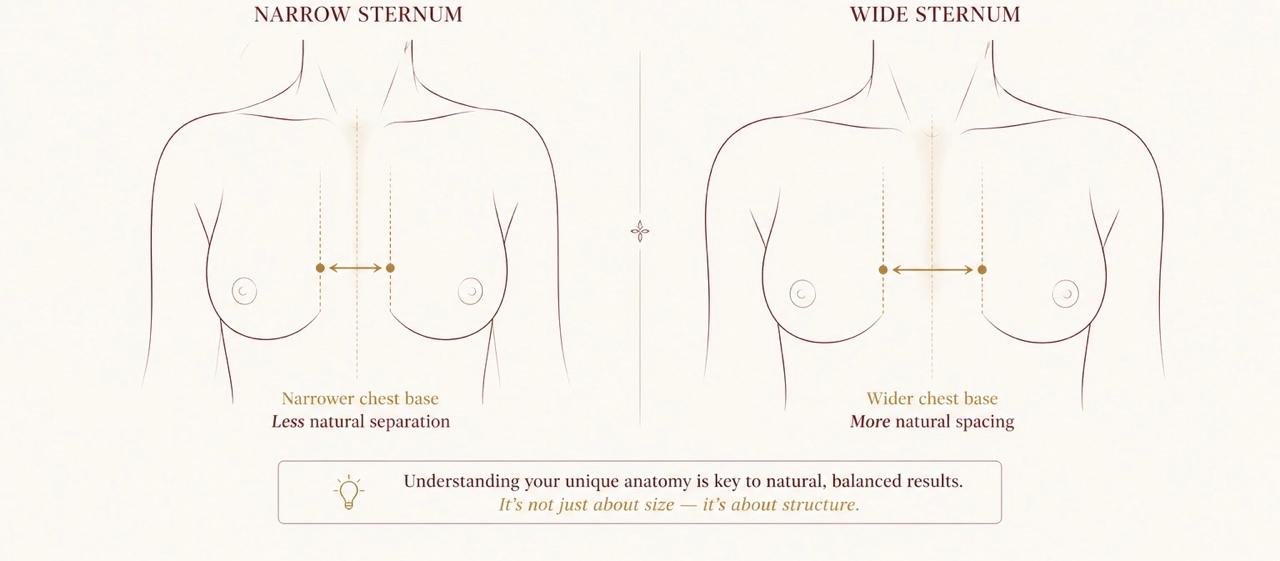
Some women naturally have breasts that sit closer together. Others have more space between them.
The width and shape of the sternum, the contour of the rib cage, the natural breast footprint and the distance between the breasts all influence this.
That is why the exact same implant can look very different in two different women.
An implant sits within an existing anatomy. It does not erase that anatomy.
Good surgical planning therefore starts by measuring and understanding your breast base, chest wall and natural spacing rather than beginning with a number of cubic centimetres.
Implant Size Is Only One Part of the Equation
Two implants with similar volumes can have very different widths and projections.
Those dimensions matter.
The implant should complement the width of the existing breast and the characteristics of the chest rather than simply being chosen because a particular volume sounds appealing.
Implant width, projection, tissue coverage and the way the pocket is designed all influence the final appearance of the breast — including how much medial fullness is visible.
This is why breast augmentation planning is better thought of as dimensional planning rather than simply choosing an implant size.
The Fold Beneath the Breast Matters More Than People Realise
The natural crease where the breast meets the chest wall is called the inframammary fold, or IMF.
It is an important landmark in breast surgery because it helps define the lower border of the breast and contributes to lower-pole shape, implant position and overall contour.
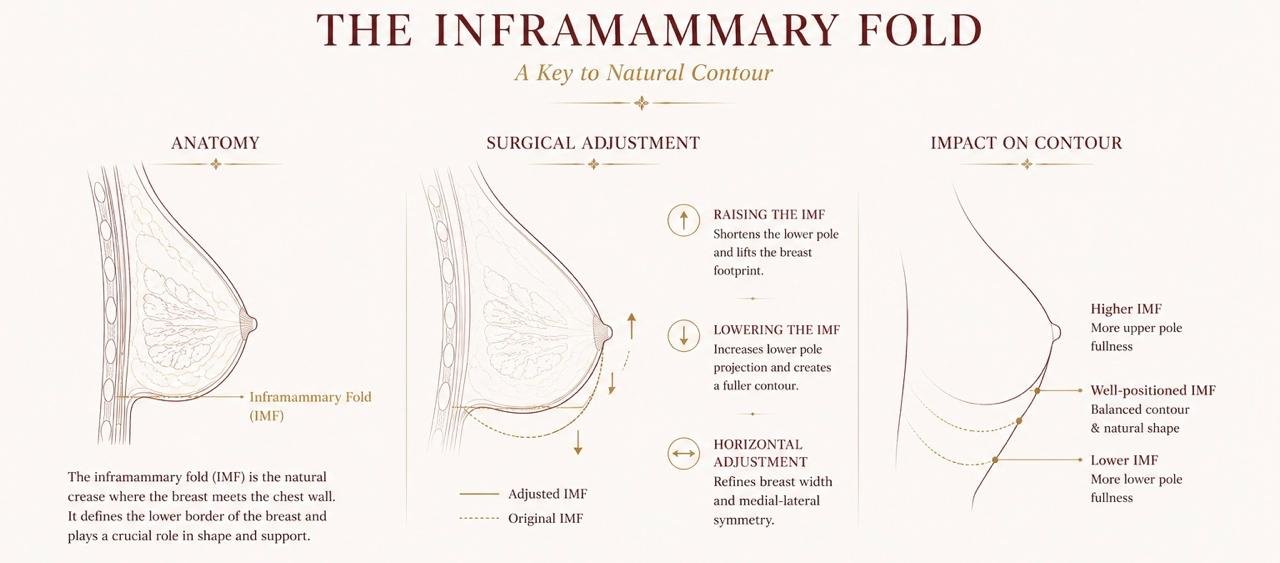
In some patients the existing fold is exactly where it needs to be and should be preserved.
In selected situations, its position may need to be adjusted to accommodate the planned implant or correct an anatomical difference.
But these adjustments need to be conservative and deliberate.
The goal is not simply to move structures in pursuit of cleavage. It is to create a breast shape that remains balanced with the patient’s own anatomy.
There Are Anatomical Limits to Cleavage
This is an important part of the consultation.
If a woman naturally has a wider sternum or a wider distance between her breasts, surgery cannot safely make that underlying anatomy disappear.
Trying to force an implant too far toward the centre of the chest can create problems rather than a natural result.
So the goal is not:
“How close can we possibly make the breasts?”
A better question is:
“What degree of medial fullness will look natural and balanced on your chest?”
Cleavage Can Be Discussed Before Surgery
One of the most useful things patients can do is describe what they actually mean when they say they want “cleavage.”
Do you want more fullness toward the centre of the chest?
Do you want the breasts to appear closer together in clothing?
Are you looking for subtle natural spacing or a more pronounced central contour?
These are useful conversations because they help the surgeon understand the aesthetic goal while also explaining what your anatomy will and will not safely allow.

What About Revision Surgery?
Revision breast surgery can be more complex because previous surgery may already have changed the implant pocket, scar tissue and soft-tissue support.
If the medial contour needs improvement, the strategy depends entirely on what is causing the problem.
In selected patients, revision may involve reshaping or reinforcing the implant pocket, changing implant dimensions, working with the existing capsule or using fat transfer to improve soft-tissue contour.
There is no universal technique because revision surgery is, by definition, surgery on an anatomy that has already been altered.
The Bottom Line
Cleavage is not random.
And it is certainly not just about implant size.
It is influenced by:
- Your natural chest anatomy and the width of the sternum
- Your existing breast footprint and natural spacing
- Implant dimensions including width and projection
- Soft-tissue coverage and the characteristics of your breast tissue
- Pocket and inframammary-fold planning
- Your own aesthetic goal interpreted within safe anatomical limits
“It’s not just about size. It’s about structure, proportion and what already belongs to you.”
This is what I mean when I talk about treating the body as a canvas.
Every plan begins with what is already there.
The goal is not to impose the same shape on every patient.
It is to understand the anatomy, understand the goal, and find where the two can meet naturally.