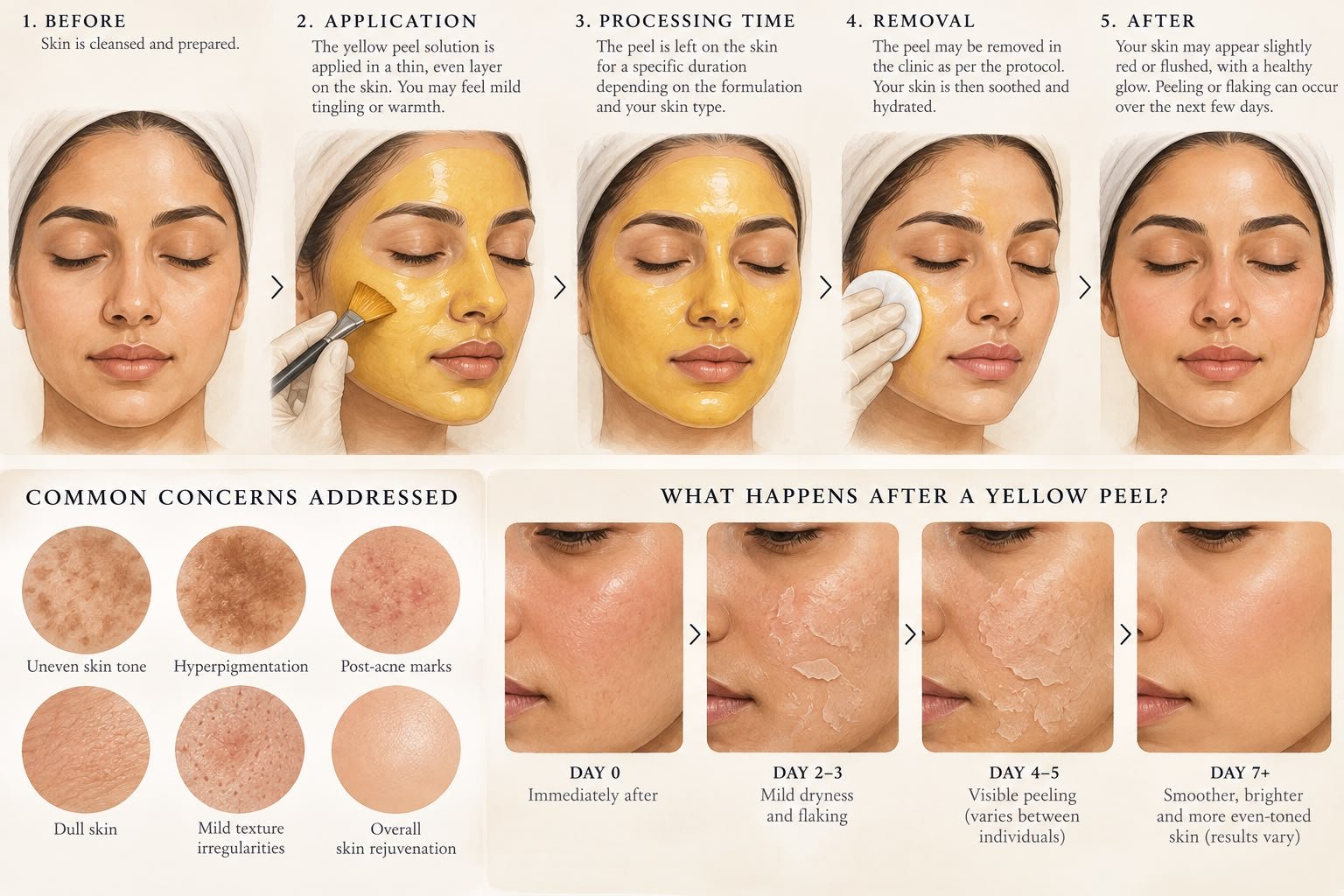
If you struggle with dullness, uneven skin tone, pigmentation or post-acne marks, you may have come across the term Yellow Peel.
But what exactly is a Yellow Peel, and is it suitable for your skin?
A Yellow Peel is a type of chemical peel used to improve skin tone, pigmentation and overall skin texture. It works by encouraging controlled exfoliation and renewal of the superficial layers of the skin.
What is a Yellow Peel?
A Yellow Peel is a multi-ingredient chemical peel designed primarily for concerns such as pigmentation, uneven skin tone and dull-looking skin.
The characteristic yellow colour comes from some of the active ingredients used in the formulation.
Depending on the formulation and the patient’s skin concerns, Yellow Peels may contain combinations of ingredients that work through exfoliation, pigment regulation and stimulation of skin renewal.
The exact formulation and concentration matter, which is why chemical peels should be selected according to the patient’s skin type and concerns rather than treated as a one-size-fits-all procedure.
What can a Yellow Peel help with?
Yellow Peels may be considered for:
- Uneven skin tone
- Hyperpigmentation
- Post-inflammatory pigmentation
- Post-acne marks
- Dull or lacklustre skin
- Mild textural irregularities
- Overall skin rejuvenation
However, not every type of pigmentation responds in the same way to a peel.
For example, melasma can be particularly challenging and may require a comprehensive approach rather than relying on a peel alone.
How does a Yellow Peel work?
Chemical peels work by producing a controlled effect on the skin, encouraging exfoliation and renewal.
Depending on the formulation, the active ingredients may also influence melanin production and pigment transfer, helping to improve the appearance of uneven pigmentation over time.
The result isn’t simply about “peeling the skin off.”
The aim is to create controlled skin renewal while maintaining the health of the skin barrier.
Is Yellow Peel the same as a regular facial?
No. A chemical peel is a medical aesthetic procedure, whereas a conventional facial is primarily a cosmetic skin-care treatment.
The depth and strength of a chemical peel depend on its formulation, concentration, application and the condition of the patient’s skin.
This is why professional assessment is important, particularly for patients with pigmentation or darker skin types where inappropriate treatment can sometimes worsen pigmentation.
What happens during a Yellow Peel?
Before treatment, your skin is assessed to determine:
- Your primary concern
- Skin type and sensitivity
- Existing pigmentation
- Previous treatments
- Current skincare products
- Any history of irritation or post-inflammatory pigmentation
The skin is then prepared and the peel is applied according to the selected protocol.
Depending on the formulation, you may experience mild warmth, tingling or stinging during application.
Some Yellow Peel protocols involve a period during which the product remains on the skin before being removed, while others are removed during the treatment itself. The exact protocol depends on the formulation being used.
What happens after a Yellow Peel?
This depends on the strength and formulation of the peel. You may experience:
- Mild redness
- Tightness
- Dryness
- Flaking or peeling
- Temporary sensitivity
Not every Yellow Peel causes dramatic visible peeling. More peeling does not necessarily mean a better result.
Your skin should be allowed to recover, and post-procedure skincare and sun protection are particularly important.
Why is sun protection important after a peel?
After exfoliation, the skin can be more sensitive to environmental exposure.
If you’re being treated for pigmentation, daily broad-spectrum sunscreen is an essential part of the treatment plan, not an optional addition.
Without adequate sun protection, pigmentation can recur or become more difficult to control.
Can Yellow Peel treat melasma?
It may have a role in a comprehensive melasma treatment plan, but melasma is not simply a layer of pigment that can be peeled away.
It is a chronic, often recurrent pigmentation disorder influenced by factors including ultraviolet and visible light exposure, hormones and individual susceptibility.
Treatment may therefore involve a combination of:
- Sun protection
- Topical medication
- Chemical peels
- Other medical aesthetic treatments
- Long-term maintenance
The appropriate approach depends on the individual.
Is Yellow Peel suitable for Indian skin?
Chemical peels can be used in Indian and other darker skin types, but treatment selection and technique are particularly important.
Skin with higher melanin content can be more prone to post-inflammatory hyperpigmentation following irritation or injury.
This is why I prefer to assess the skin first rather than choosing a peel simply because it is marketed for pigmentation.
How many sessions will I need?
There isn’t one fixed number of sessions that works for everyone. The number and frequency of treatments depend on:
- The type and severity of pigmentation
- Skin sensitivity
- Your response to previous treatments
- Your skincare routine
- Sun exposure
- Whether you have conditions such as melasma or post-inflammatory pigmentation
Your treatment plan should be individualised rather than based on a predetermined number of sessions.
Yellow Peel vs other pigmentation treatments
There are several approaches to pigmentation, including topical treatments, chemical peels and selected device-based treatments. The right treatment depends on why the pigmentation is present.
Pigmentation is a symptom, not always a diagnosis. Before treating it, we need to understand what is causing it.
Frequently asked questions
Does Yellow Peel permanently remove pigmentation?
No treatment can guarantee permanent removal of pigmentation. Pigmentation can recur, particularly when the underlying trigger persists.
Will my skin peel after treatment?
Possibly, depending on the formulation and protocol. Some patients experience visible peeling, while others experience mainly dryness or mild flaking.
Is Yellow Peel painful?
Most patients experience some degree of tingling, warmth or stinging, but the sensation varies depending on the formulation and individual sensitivity.
Can I wear makeup after a Yellow Peel?
This depends on the specific peel and your skin’s condition afterwards. Your treating doctor will advise you when it is appropriate to resume makeup.
Can I use my normal skincare after the peel?
Not immediately in every case. Irritating active ingredients may need to be paused temporarily while the skin barrier recovers. Your post-peel instructions should be individualised.
The goal isn’t simply to peel. It’s to treat the skin intelligently.
A brighter complexion shouldn’t come at the expense of a healthy skin barrier.
At Magnum Opus Plastic Surgery & Medical Aesthetics, the focus is on understanding your skin, identifying the cause of your pigmentation and selecting treatments appropriate for your individual needs.
Healthy skin first. Results follow.
Book a consultation with Dr Catherine Samraj to discuss pigmentation, uneven skin tone or skin rejuvenation.