A scar is the body’s way of healing after an injury or surgery. But sometimes, the scar can become tight, wide, raised, or positioned in a way that makes it more noticeable or restricts movement.
This is where Z-plasty can be useful.
Z-plasty is a surgical scar-revision technique that changes the direction and orientation of a scar, helping to make it less conspicuous and, in selected cases, improve tightness or restriction caused by a contracted scar.
What is a Z-plasty?
Despite its name, Z-plasty does not simply mean “removing a scar.”
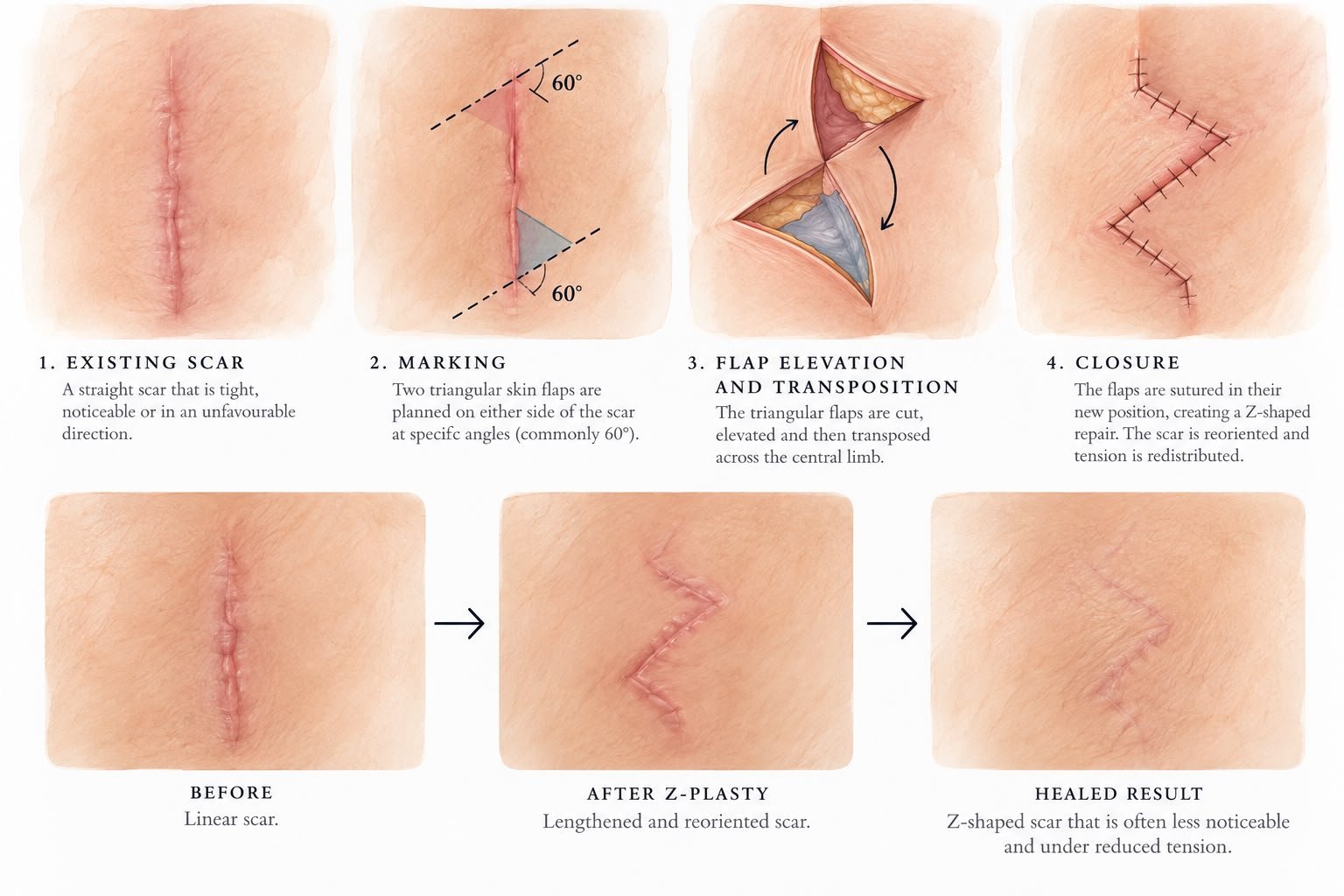
It is a technique in which the surgeon plans Z-shaped incisions, creating two triangular skin flaps on either side of the existing scar. These flaps are then transposed, or exchanged in position.
This changes the direction of the central scar and redistributes tension across the surrounding skin.
The final scar therefore follows a different path rather than remaining as one straight line.
Why would you need a Z-plasty?
Z-plasty may be particularly useful when a scar:
- Feels tight or contracted
- Restricts movement across a joint or body area
- Lies in an unfavourable direction
- Has become conspicuous because of tension
- Needs to be repositioned to better follow natural skin lines
- Is causing functional or cosmetic concerns
It can be used for selected scars following trauma, burns, previous surgery or other injuries. A wide or raised scar does not automatically need Z-plasty; the underlying problem determines the treatment.
How does Z-plasty work?
The principle is relatively simple, although the planning is highly individualised.
The existing scar forms the central limb of the Z. Additional limbs are planned at carefully selected angles, creating skin flaps that can then be transposed.
This allows the contracted segment to be lengthened, the central scar to be reoriented and tension to be redistributed.
The amount of lengthening achieved depends on the design and angles used, as well as the location and characteristics of the scar and surrounding skin.
Does Z-plasty remove the scar completely?
No. This is one of the most important things to understand about scar revision.
Z-plasty does not make a scar disappear. Instead, it changes the scar’s direction, length and relationship with the surrounding skin.
The aim is to create a scar that is less noticeable and, where appropriate, improve restriction or contracture.
Scar maturation also takes time. Even after a technically successful procedure, the scar may initially appear pink, firm or raised before gradually becoming softer and less noticeable.
Can Z-plasty improve a tight scar?
Yes. One of the important applications of Z-plasty is the treatment of scar contracture.
A contracted scar can shorten the surrounding skin and restrict movement. By rearranging the scar and adjacent skin, Z-plasty can help lengthen the contracted segment and redistribute tension.
This can be particularly relevant for scars around areas where movement is important.
Is every scar suitable for Z-plasty?
No. Z-plasty is one of several scar-revision techniques, and the best approach depends on the individual scar.
During a consultation, I would assess factors such as:
- Scar location
- Length and width
- Direction of the scar
- Skin laxity
- Scar maturity
- Degree of contracture
- Previous surgery or injury
- Skin type and healing characteristics
Depending on these factors, another scar-revision technique may be more appropriate.
What happens during the procedure?
Z-plasty may be performed under local anaesthesia or another form of anaesthesia depending on the size and location of the scar and the planned procedure.
The scar and surrounding skin are carefully marked before surgery. The planned skin flaps are then created and rearranged so that the central scar follows a new direction.
The incision is closed carefully, with the aim of minimising tension and creating a fine, well-positioned scar.
What should you expect after Z-plasty?
Some swelling, redness and tenderness are expected during the early healing period.
As the scar heals, it will gradually change in appearance. Scar maturation can take several months and sometimes longer.
Your aftercare may include wound care, sun protection and, depending on the scar and your healing, silicone-based scar therapy or other scar-management measures.
Your surgeon will advise you on when you can resume normal activities based on the location and extent of the procedure.
For more on how scars change over time, read Understanding Scars: How Healing Really Works.
Z-plasty: frequently asked questions
Does Z-plasty make scars disappear?
No. The goal is to improve the appearance, direction or function of a scar, rather than erase it completely.
Is Z-plasty painful?
The procedure itself is performed with appropriate anaesthesia. Some soreness or tightness can be expected during the initial healing period.
Can an old scar be treated with Z-plasty?
Sometimes. Scar revision can be considered for mature scars as well as problematic scars that have developed following previous surgery or trauma. Suitability needs to be assessed individually.
Will the new scar be shaped like a Z?
The incisions and resulting scar form a zigzag pattern, with the central segment changing direction as the flaps are transposed. The scar remains, although it may become less conspicuous as it matures. Its final appearance varies between patients.
How long does a Z-plasty take to heal?
Initial wound healing occurs over the first few weeks, but scar maturation takes considerably longer. The final appearance should not be judged too early.
The goal isn’t to erase a scar. It’s to improve it.
Scar revision is about understanding how a scar behaves, how it interacts with surrounding skin, and what is realistically achievable.
For some patients, Z-plasty can be an elegant solution—particularly when a scar is tight, contracted or poorly oriented.
If you have a scar that concerns you, an assessment with a plastic surgeon can help determine whether Z-plasty, another scar-revision technique, or non-surgical scar management is the most appropriate option.
Your scar has a story. Let’s help it heal better.
Book a consultation with Dr Catherine Samraj at Magnum Opus Plastic Surgery & Medical Aesthetics.